Ciutat Vella
Barcelona's historic core: four dense neighbourhoods between walls, port and intense tourism.
Ciutat Vella is not a former annexed town but the long core of Barcelona itself — Roman Barcino, medieval expansion, port work and, today, extreme visitor pressure. Its four neighbourhoods (Raval, Gòtic, Barceloneta, Sant Pere-Santa Caterina-la Ribera) hold sharply different fabrics and social structures under one district label. Internal inequality is extreme: tourist frontages beside overcrowded flats; cultural institutions beside street economies of survival. The district groups 4 neighbourhoods with a combined registered population of about 115,829 (padró 2026). The comparative table uses the same definitions and years for every barri. Internal inequalities — income, density, tourism, self-built or Eixample histories — are best read neighbourhood by neighbourhood. Each has its own page with sources.
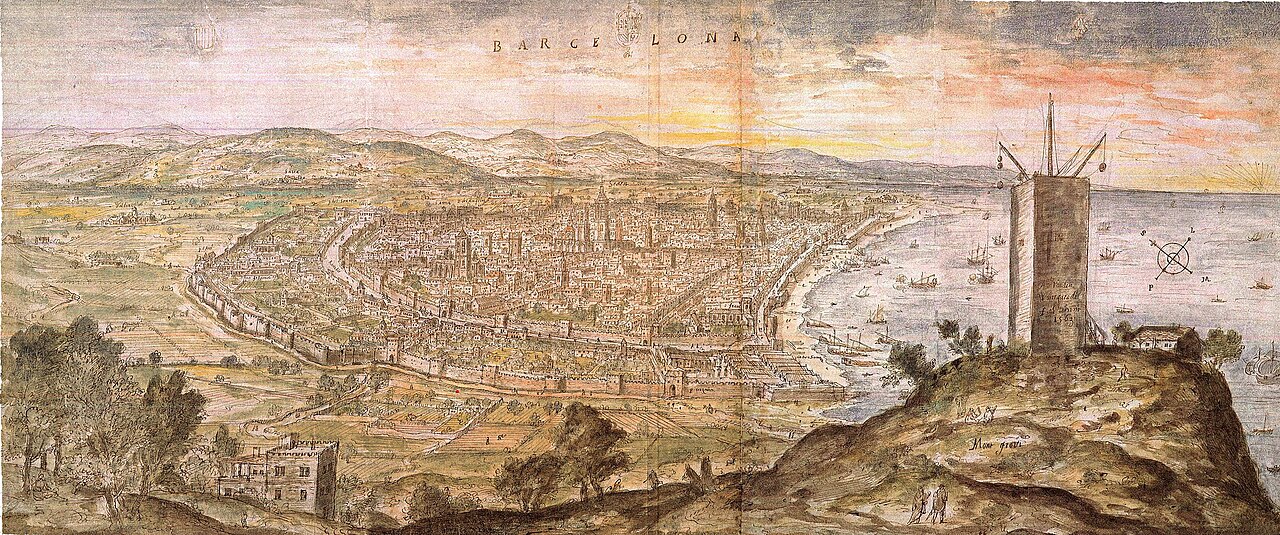
Panoramic view of Barcelona drawn by Anton van den Wyngaerde, 1563.
Wikimedia Commons · public domain · source

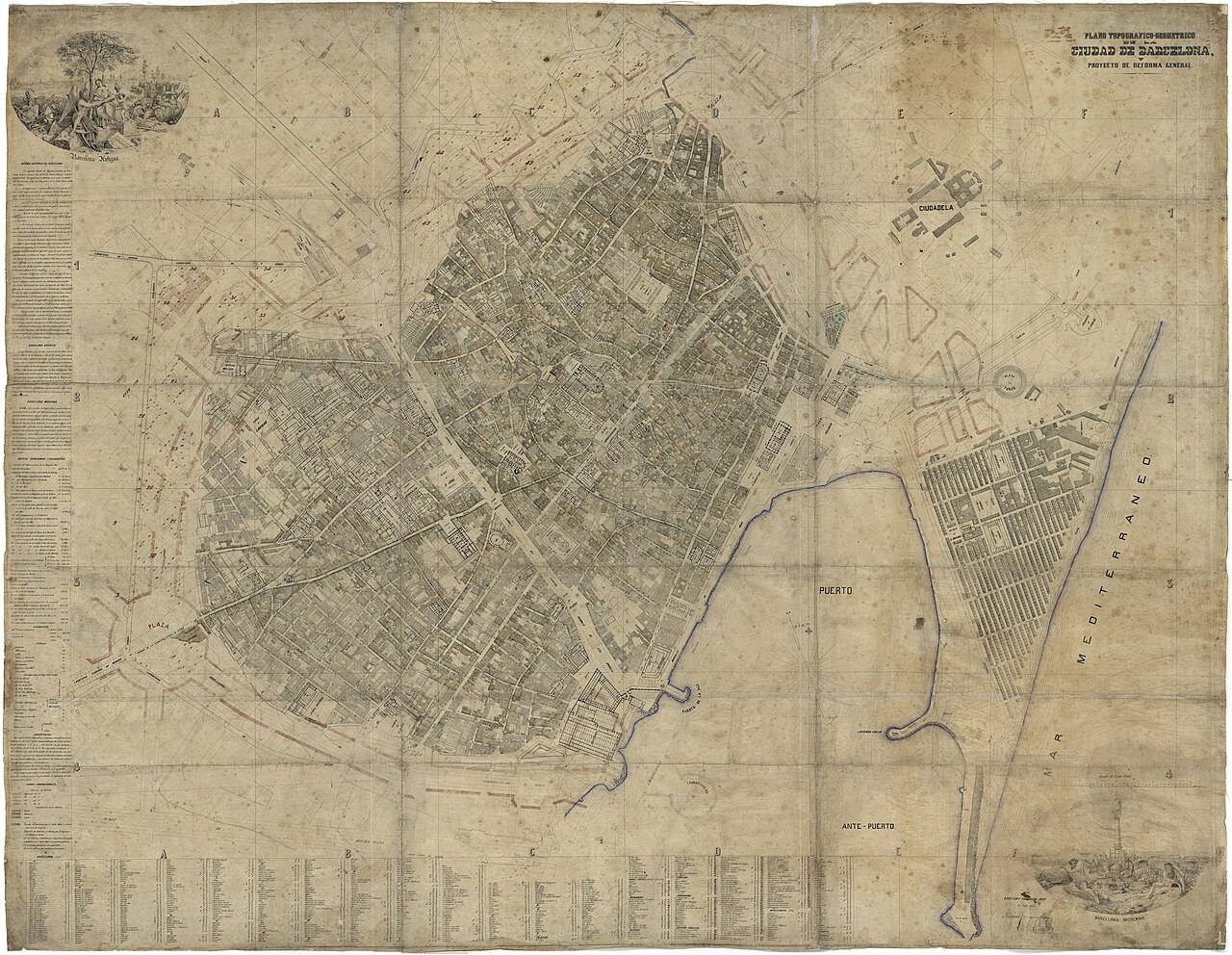
Plan of Barcelona shortly before Cerdà’s Eixample (1858).
Wikimedia Commons · Miquel Garriga i Roca · CC BY 4.0 · source

Neighbourhood directory
| Neighbourhood | Population | Density | Mean disposable income of census sections |
|---|---|---|---|
| el Raval | 50,863 | 462.4 | 16,416 |
| el Barri Gòtic | 27,312 | 334.7 | 22,139 |
| la Barceloneta | 14,665 | 124.4 | 20,818 |
| Sant Pere, Santa Caterina i la Ribera | 22,989 | 207.1 | 22,764 |
- el Raval — West of La Rambla, the Raval is the former extramural suburb turned into one of Barcelona’s densest urban worlds: convents and hospitals, workshops and working-class housing, successive migrations, major cultural institutions and a continuing struggle over homes and public space.
- el Barri Gòtic — Barcelona’s Roman and medieval core, recomposed in the twentieth century as a monumental “Gothic Quarter”: beneath the old stone are Barcino, the Call, inhabited homes, streets erased by Via Laietana and a heritage image that is itself modern.
- la Barceloneta — A neighbourhood planned in 1753 by the military engineer Juan Martín Cermeño on sand won from the sea: a grid of 15 parallel streets and 9 cross streets, with low houses that the nineteenth century raised higher and divided into more flats.
- Sant Pere, Santa Caterina i la Ribera — Three former neighbourhoods —la Ribera, Santa Caterina and Sant Pere— joined in one administrative neighbourhood inside the old wall, marked by the demolition of part of la Ribera to build the Citadel after 1714.