The industrial city and what remains of it
A chimney is not a factory. To understand industrial Barcelona, brick walls must be reconnected to energy, transport, housing, pollution and labour.
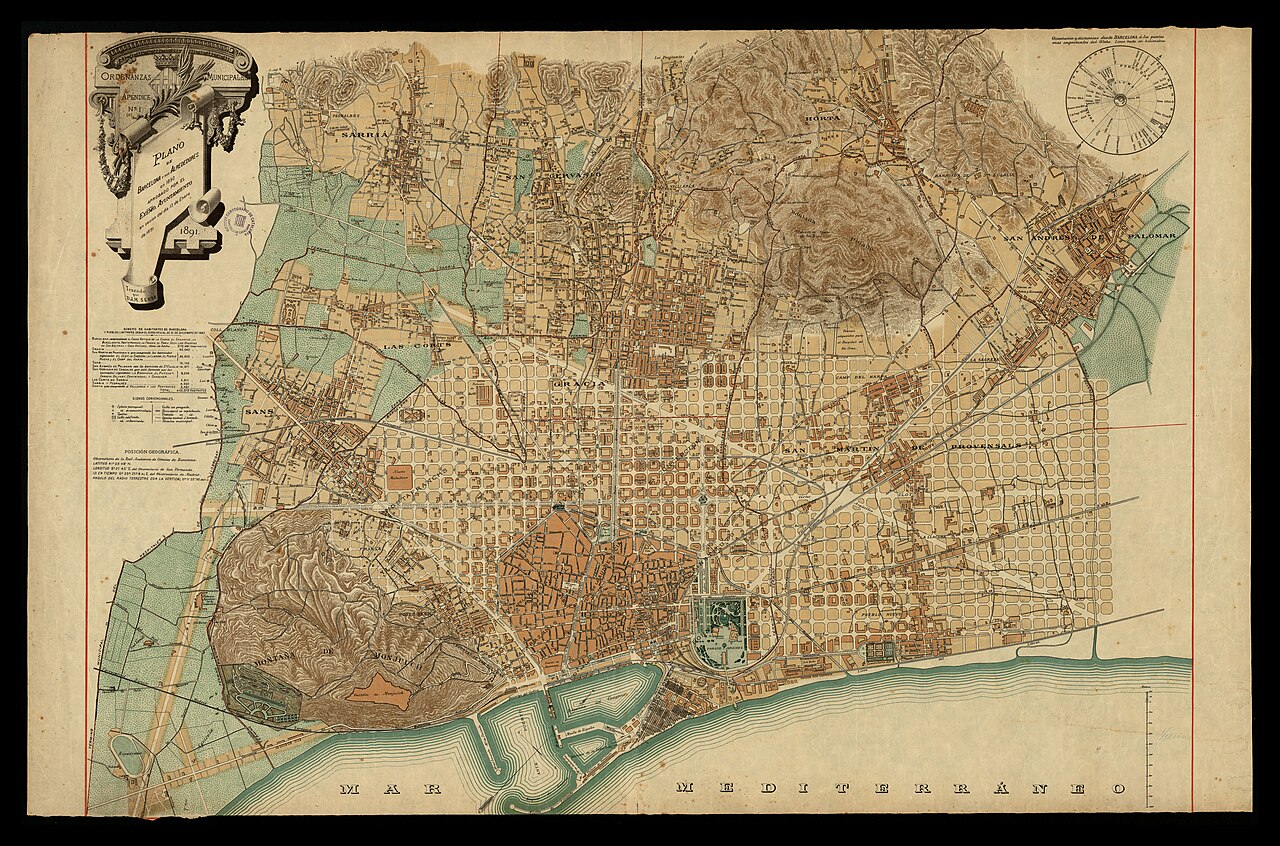
Plan of Barcelona and its surroundings around 1890, with the Eixample expanding.
Wikimedia Commons · public domain · source

The chimney alone
In Poblenou, a brick chimney may now stand among offices, new apartments and open space. It is a powerful image and a misleading one. The vertical fragment can make industry look chiefly architectural. A factory was a network. It required coal or electricity, water, railway access, warehouses, machinery, suppliers, nearby homes and thousands of hours of human labour.[1]
When only the chimney survives, the city preserves a sign and may lose the system that gave it meaning. Reading industrial heritage requires asking what was produced, who worked there, how materials arrived, what waste was created and what forms of life grew around the plant.
Poblenou: more than brick scenery
The industrialisation of Sant Martí concentrated textile, metal, food and chemical production in Poblenou. Long plots, passages, railway lines and workers’ housing formed a productive ecology. Access to the coast, rail transport and available land encouraged factories to settle there; pollution and danger were concentrated in the same territory.[2]
Closure did not immediately erase that geography. Workshops, warehouses, artists and small firms reused industrial buildings. Later, the redevelopment associated with 22@ transformed many plots into offices, facilities and housing. The question was no longer simply what could be preserved, but who could continue producing and living in the new landscape.
Different industrial systems
In Sant Andreu, Fabra i Coats represents a large factory connected to an older urban centre. In la Bordeta, Can Batlló occupied an extensive enclosure that related work, perimeter walls and neighbouring streets. Around Bon Pastor and Baró de Viver, La Maquinista linked heavy industry, railway and river to a working-class periphery. In the Raval, earlier industrialisation operated at a compressed scale among housing, secularised convents and narrow streets. There was no single Barcelona factory. A Poblenou hall, the large Sant Andreu enclosure, heavy industry beside the Besòs and a workshop inserted into the old city produced different relationships between labour and neighbourhood.
What protection protects
Heritage catalogues can preserve façades, chimneys, structures and groups of buildings. This matters, but it does not guarantee that labour history remains legible. An immaculately renovated hall can become an object without workers. A rough building still used for production may preserve more social continuity than a restored monument. This does not mean that every factory must retain its original use. It means that conversion should make visible what has been replaced: production, labour conflict, women’s work, migration, accidents, noise and pollution. Red brick does not make heritage innocent.
Reconnecting the fragment
To read an industrial remainder, look beyond the building. Where was the railway? Where did the water come from? What housing stood within a five-minute walk? Which workers’ institutions grew nearby? What happened to the land after closure? The Poblenou chimney remains upright. Once its connections are restored, it stops being scenery. It belongs again to a city that manufactured things and was itself made by the people who worked there.
Static map: official neighbourhood boundaries (CartoBCN)
Related neighbourhoods
Sources
- [1] BCNROC. Industrial heritage of Poblenou. ↩
- [2] BCNROC. Industrial heritage protection plan. ↩
- [3] MUHBA Oliva Artés. La formació d’una metròpoli.