Eixample
Cerdà's Eixample: the chamfered grid that turned the plain into a dense bourgeois city.
The Eixample is the nineteenth-century extension planned by Ildefons Cerdà after the walls fell. Its six neighbourhoods record status gradients (Dreta/Esquerra), monument tourism (Sagrada Família), market culture (Sant Antoni) and the western industrial edge. Superilles experiments now rewrite street space without erasing the grid. The district groups 6 neighbourhoods with a combined registered population of about 277,353 (padró 2026). The comparative table uses the same definitions and years for every barri. Internal inequalities — income, density, tourism, self-built or Eixample histories — are best read neighbourhood by neighbourhood. Each has its own page with sources.
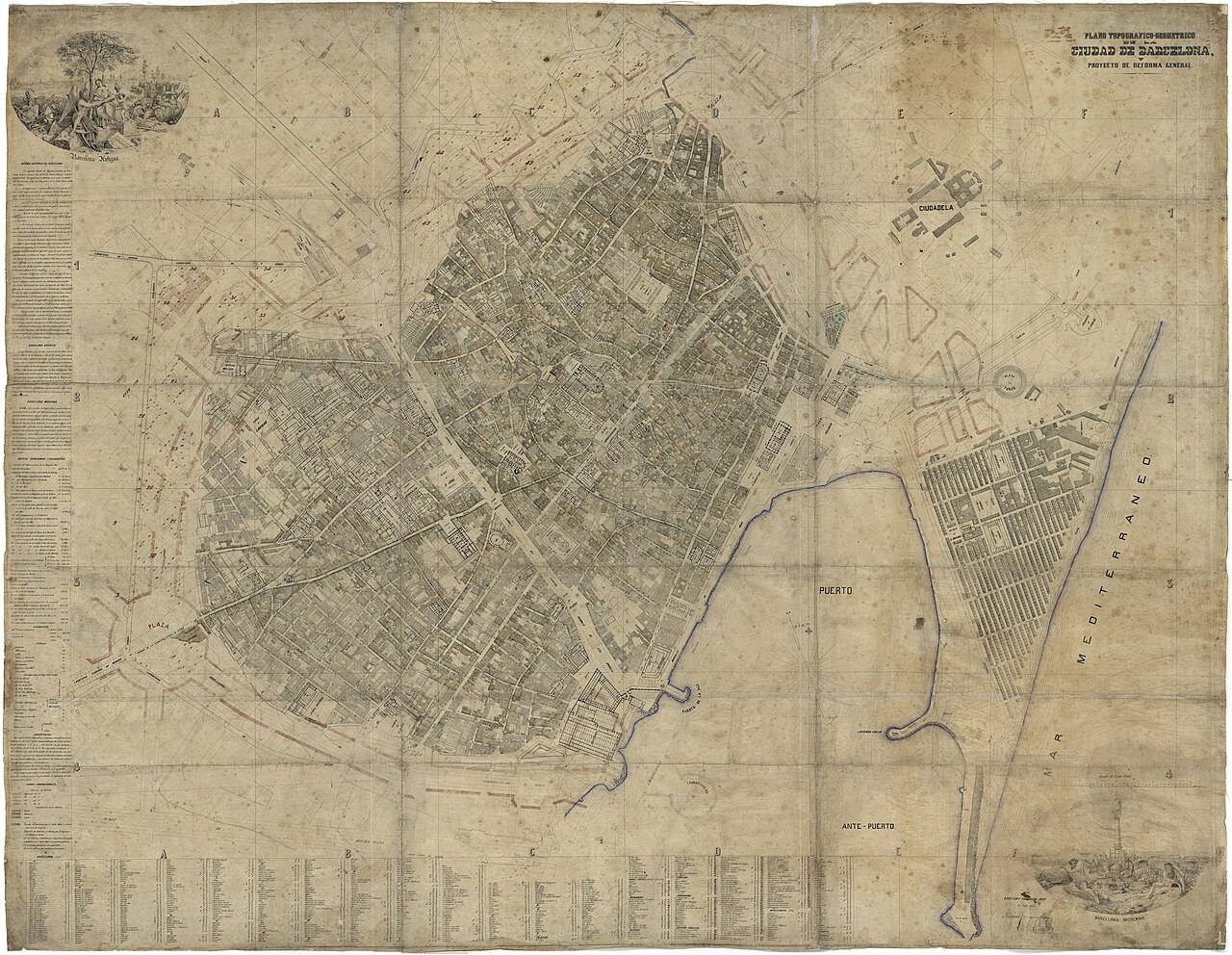
Plan of Barcelona shortly before Cerdà’s Eixample (1858).
Wikimedia Commons · Miquel Garriga i Roca · CC BY 4.0 · source

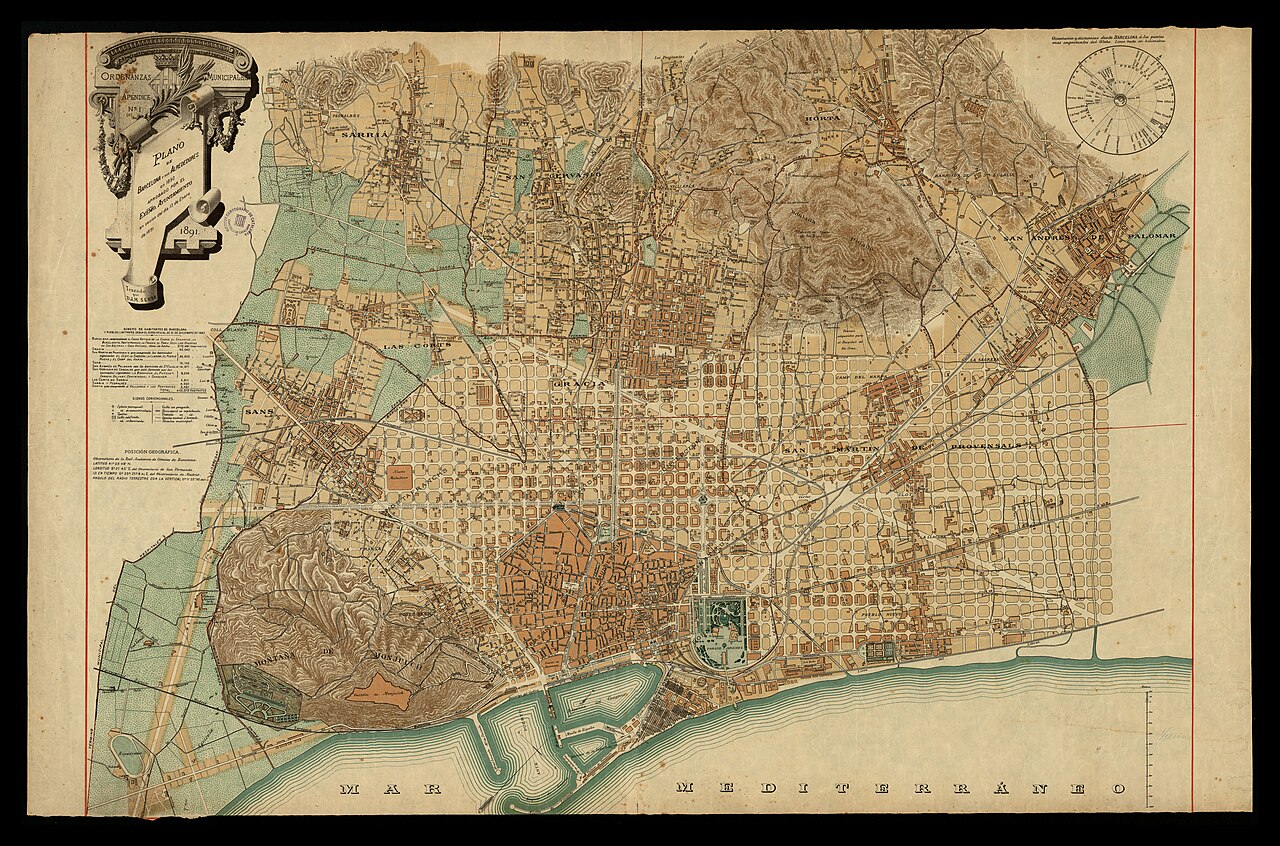
Plan of Barcelona and its surroundings around 1890, with the Eixample expanding.
Wikimedia Commons · public domain · source

Neighbourhood directory
| Neighbourhood | Population | Density | Mean disposable income of census sections |
|---|---|---|---|
| el Fort Pienc | 37,672 | 405.5 | 27,241 |
| la Sagrada Família | 53,201 | 510.6 | 25,915 |
| la Dreta de l'Eixample | 45,464 | 214.5 | 35,332 |
| l'Antiga Esquerra de l'Eixample | 42,921 | 349.5 | 32,767 |
| la Nova Esquerra de l'Eixample | 59,117 | 440.8 | 29,378 |
| Sant Antoni | 38,978 | 484.8 | 26,589 |
- el Fort Pienc — An Eixample neighbourhood that grew on a plain of roads and infrastructure outside the walls, bearing the name of a vanished fort and shaped by railway tracks and the Estació del Nord, today turned into a park, a concert hall and a theatre.
- la Sagrada Família — La Sagrada Família is the Eixample neighbourhood named after Gaudí's temple, raised over the fields and low houses of the old Poblet and still under construction in 2026.
- la Dreta de l'Eixample — La Dreta de l'Eixample is the central sector of Cerdà's Eixample, where Barcelona's bourgeoisie built modernista homes around Passeig de Gràcia, and it takes its name from lying to the right of the Sarrià railway that once ran down Carrer de Balmes.
- l'Antiga Esquerra de l'Eixample — L'Antiga Esquerra de l'Eixample is the western part of the Eixample that was urbanised first, and today the Hospital Clínic, the historic building of the Universitat de Barcelona and the Mercat del Ninot can all be read in it.
- la Nova Esquerra de l'Eixample — La Nova Esquerra de l'Eixample is the newer part of the Esquerra de l'Eixample, where the grid absorbed a cotton mill, a prison, an abattoir and a bullring, and where an industrial school, a park and a shopping centre now stand.
- Sant Antoni — Sant Antoni grew around the iron market that Antoni Rovira i Trias opened in 1882 beside the old city wall, and its streets are now being rebuilt around it as a pedestrian superilla.