Sant Martí
Sant Martí: from Poblenou's Catalan Manchester to Diagonal Mar towers and Besòs estates.
The former municipality of Sant Martí de Provençals hosted Barcelona's densest industrial concentration. Olympic village, 22@, Forum-era waterfront and unequal popular estates now share one district — a map of production, spectacle and periphery. The district groups 10 neighbourhoods with a combined registered population of about 252,625 (padró 2026). The comparative table uses the same definitions and years for every barri. Internal inequalities — income, density, tourism, self-built or Eixample histories — are best read neighbourhood by neighbourhood. Each has its own page with sources.
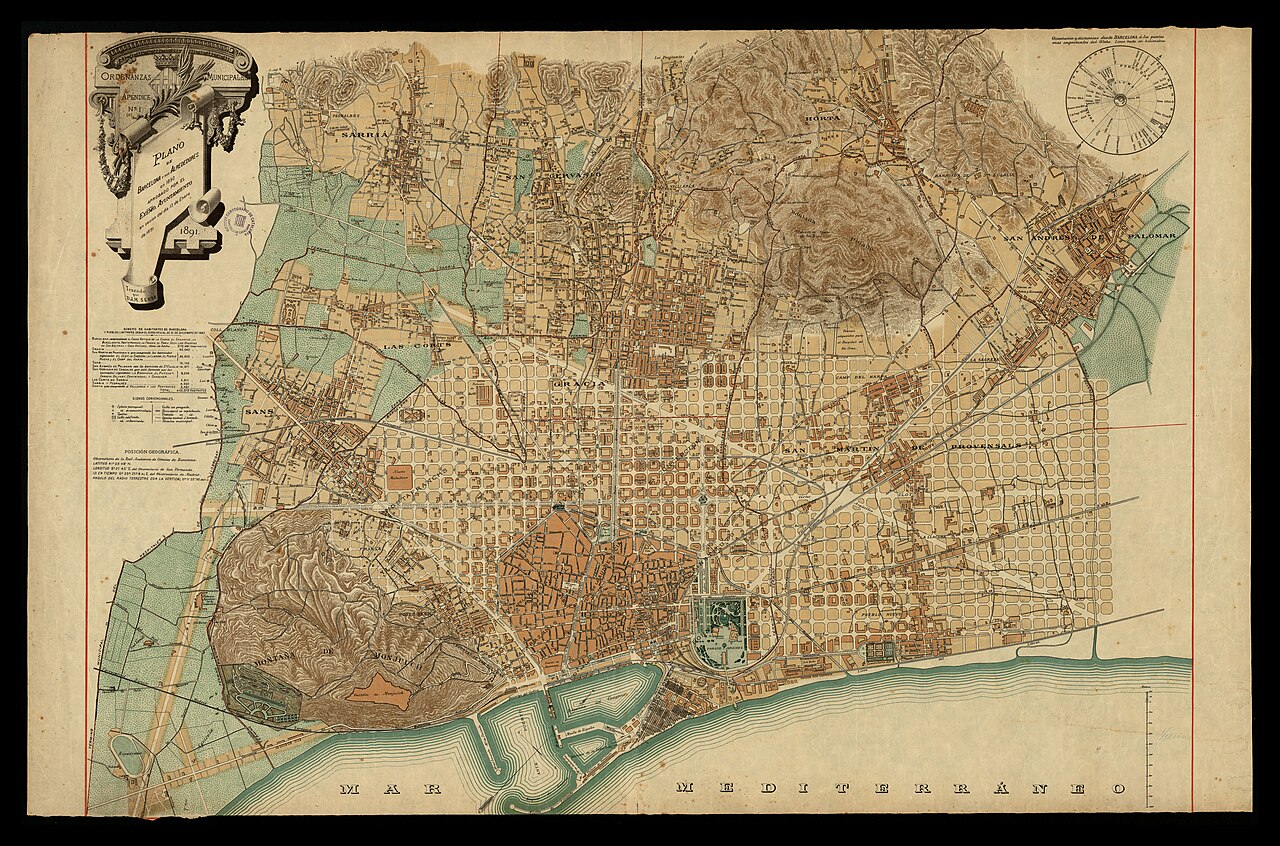
Plan of Barcelona and its surroundings around 1890, with the Eixample expanding.
Wikimedia Commons · public domain · source

Neighbourhood directory
| Neighbourhood | Population | Density | Mean disposable income of census sections |
|---|---|---|---|
| el Camp de l'Arpa del Clot | 39,535 | 533.5 | 24,664 |
| el Clot | 26,907 | 386 | 24,470 |
| el Parc i la Llacuna del Poblenou | 17,639 | 157.2 | 26,699 |
| la Vila Olímpica del Poblenou | 9,293 | 100.5 | 36,618 |
| el Poblenou | 34,736 | 221.7 | 27,093 |
| Diagonal Mar i el Front Marítim del Poblenou | 13,771 | 112.2 | 28,985 |
| el Besòs i el Maresme | 30,695 | 253.9 | 16,908 |
| Provençals del Poblenou | 22,076 | 203.3 | 23,093 |
| Sant Martí de Provençals | 27,035 | 368.3 | 21,756 |
| la Verneda i la Pau | 30,938 | 273.8 | 20,083 |
- el Camp de l'Arpa del Clot — El Camp de l'Arpa del Clot began to be built up after 1845 without following the Cerdà plan: that is why 19th-century passages, converted old factories and Eixample streets that stop dead at Carrer de Rogent survive here.
- el Clot — El Clot is an old nucleus of Sant Martí de Provençals, documented in 1208 as the Clot de la Mel, that can still be read today in Carrer del Clot, an 1889 market, a flour mill turned cultural centre and a park built on railway workshops.
- el Parc i la Llacuna del Poblenou — A former factory district of Poblenou where a brick textile mill, a design museum and a tower some 142 metres tall line up on one short walk, on land the 22@ plan has remade.
- la Vila Olímpica del Poblenou — The Olympic Village looks as though it appeared whole in 1992, but it stands on Icària, a small industrial quarter of about forty companies and 504 residents that bulldozers began to clear on 3 August 1987.
- el Poblenou — Poblenou grew in the nineteenth century into Barcelona’s industrial district, the “Catalan Manchester”; since 2000 the 22@ plan has been transforming its factory land, and the Rambla, Can Felipa and the cemetery still stand among the changes.
- Diagonal Mar i el Front Marítim del Poblenou — A neighbourhood of two ages: houses from the late 1960s on former fields and, since the early 2000s, a park by Miralles and Tagliabue, a convention centre and residential towers by the sea.
- el Besòs i el Maresme — A neighbourhood of housing blocks from the 1950s and 1960s on Barcelona's north-eastern edge, beside the Fòrum, where in May 2026 a EUR 415 million, ten-year plan was agreed to repair up to 4,000 homes.
- Provençals del Poblenou — Provençals del Poblenou is a neighbourhood drawn in 2006 along the old industrial axis of Carrer de Pere IV, where a printing works of 1853, a machinery workshop and a park by Jean Nouvel now stand close together, in the part of the neighbourhood that belongs to the 22@ sector.
- Sant Martí de Provençals — Sant Martí de Provençals is the neighbourhood that keeps the old parish centre of the municipality that once covered much of eastern Barcelona: a church on a small square, farmhouses and former fields now inside a park, all surrounded by dense housing.
- la Verneda i la Pau — La Verneda i la Pau is a neighbourhood of layers: farmland and farmhouses until the 1950s, then housing for incoming migrants, the La Pau estate inaugurated in 1966, and a square won for the city at the start of municipal democracy.