The Olympic transformation and its uneven legacy
The 1992 Games did not build a new city in a fortnight. They accelerated roads, beaches, housing and projects that distributed access, value and loss unevenly.
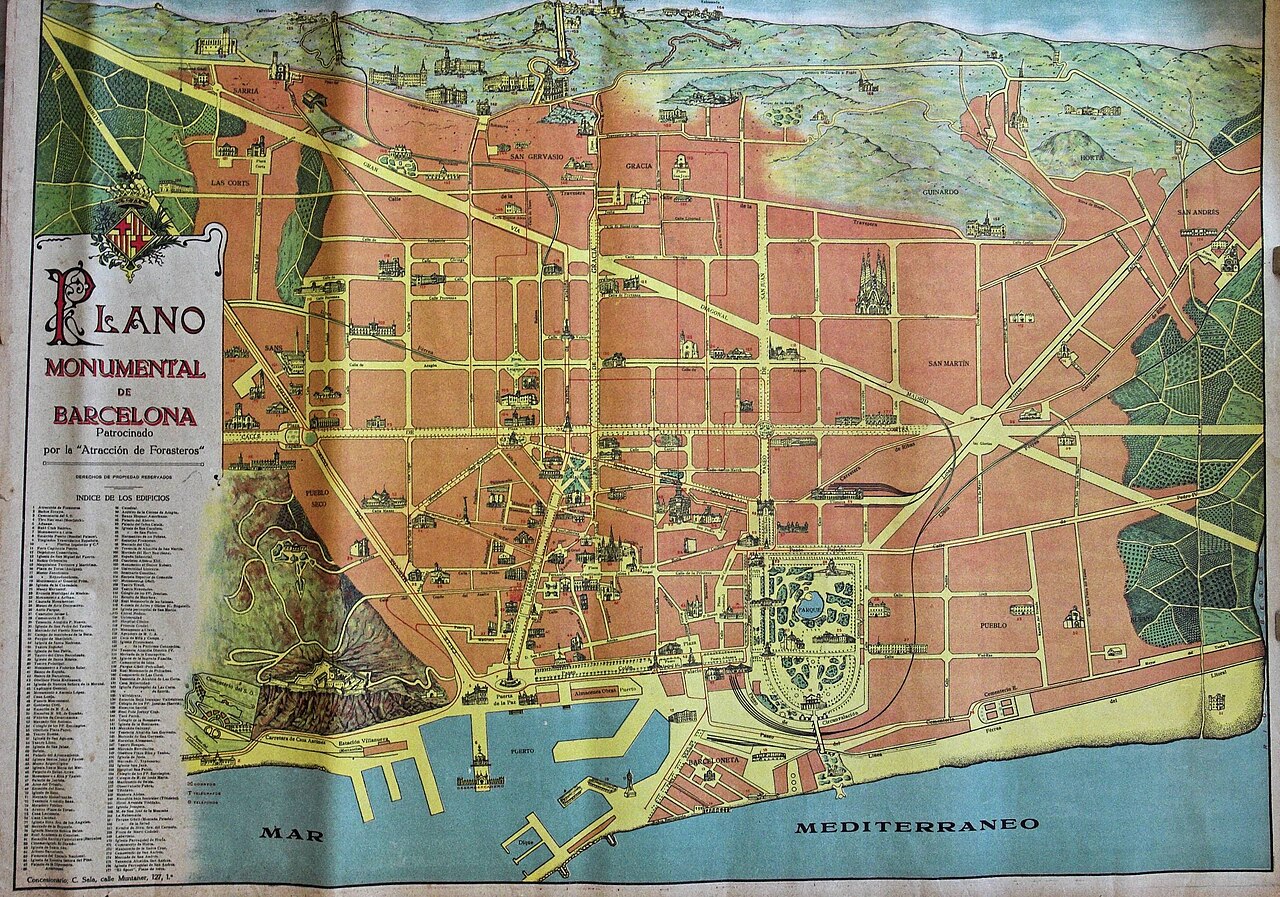
Map of Barcelona published in 1920, when the urban fabric was already much larger.
Wikimedia Commons · CC BY-SA 4.0 · source

A beach that looks inevitable
From the seafront promenade, Barcelona’s relationship with the Mediterranean can look natural: beach, bicycles, palms, housing and towers. This coastline is an urban work. Railways, industry, sewers, precarious settlements and port infrastructure had separated many neighbourhoods from the water. Olympic transformation removed, displaced or reorganised part of that world to create a new maritime front.[1]
The result is one of the period’s major public gains: continuous access to beaches and spaces previously blocked. It is also a rewriting. The present beach can conceal Somorrostro, industrial labour and communities that occupied a very different coast.[2]
The event as accelerator
The Games supplied deadlines, funding and legitimacy to projects extending far beyond sports venues. The ring roads reorganised metropolitan movement; Vila Olímpica replaced industrial fabric in Poblenou; Montjuïc concentrated facilities; Vall d’Hebron and other areas received development and infrastructure. This is the power and danger of a mega-event. It can deliver connections postponed for years. It also compresses discussion and turns the calendar into an argument. What does not fit the project may be condemned to disappear before its value has been debated.
Vila Olímpica and the new coast
Vila Olímpica created homes, streets, parks and a new maritime centre. Its plan and architecture replaced a substantial part of the Icària industrial landscape. The city gained continuity and services while losing a productive geography that was not preserved with the same force as the new residential image. This does not make the operation a simple mistake. It reveals the exchange. Opening the sea required decisions about what counted as obstacle and what deserved continuity. Industrial memory survived in fragments: names, isolated structures and later historical work.
Ring roads: connection and edge
The new road network reduced traffic in some central areas and connected the metropolis differently. A ring road is also a boundary. Where it meets neighbourhoods it produces noise, cuttings, underpasses and difficult edges. Metropolitan benefit concentrates in movement; local cost remains beside the carriageway. Olympic legacy has to be read at both scales. Infrastructure can improve general accessibility while damaging the daily continuity of a street or neighbourhood.
The image that kept working
The Games projected an open, designed, Mediterranean Barcelona. That image continued generating tourism, investment and prestige long after 1992.[3] It also increased the value of spaces previously treated as industrial or peripheral. The opened coastline did not remain outside the market; it became one of its most desirable territories. Legacy is therefore more than the completed works. It is the economic and symbolic process those works set in motion.
Inheriting transformation
One generation inherited beaches, parks, ring roads and facilities. It also inherited maintenance costs, road barriers, erased memories and a model of success later projects would try to reproduce. On the promenade, the sea appears to have always been within reach. The great skill of the Olympic transformation is making its own construction seem natural. Reading its legacy means seeing the decision inside the landscape again.
Static map: official neighbourhood boundaries (CartoBCN)
Related neighbourhoods
Sources
- [1] BCNROC. Barcelona Olympic transformation. ↩
- [2] MUHBA. De la platja al port. ↩
- [3] MUHBA Oliva Artés. La formació d’una metròpoli. ↩